
The Workplace Relationship Course Correction Menu
A practical framework for improving any workplace relationship through small, strategic adjustments.
When communication breaks down or trust erodes, people often feel stuck — repeating the same approaches without seeing meaningful change. This framework provides a structured way to understand what’s happening and take more effective, intentional action.
Workplace Relationships are Complicated

When workplace relationships become strained, the impact extends beyond the relationship itself. It affects results — for the organization and for our own careers — and often creates a lingering sense of tension that makes work harder than it needs to be.
Strategies that may have worked in the past no longer produce the same results. When we’re unsure how to move things forward, we often fall into familiar patterns:
Avoiding the person or working around them
Trying to resolve everything in one large, high-stakes confrontation
Waiting for the situation to improve on its own, even when problems persist
Meanwhile, the work suffers, and we’re left with a quiet sense of disappointment — knowing we’re no longer operating at our best.
Get Any Workplace Relationship Unstuck
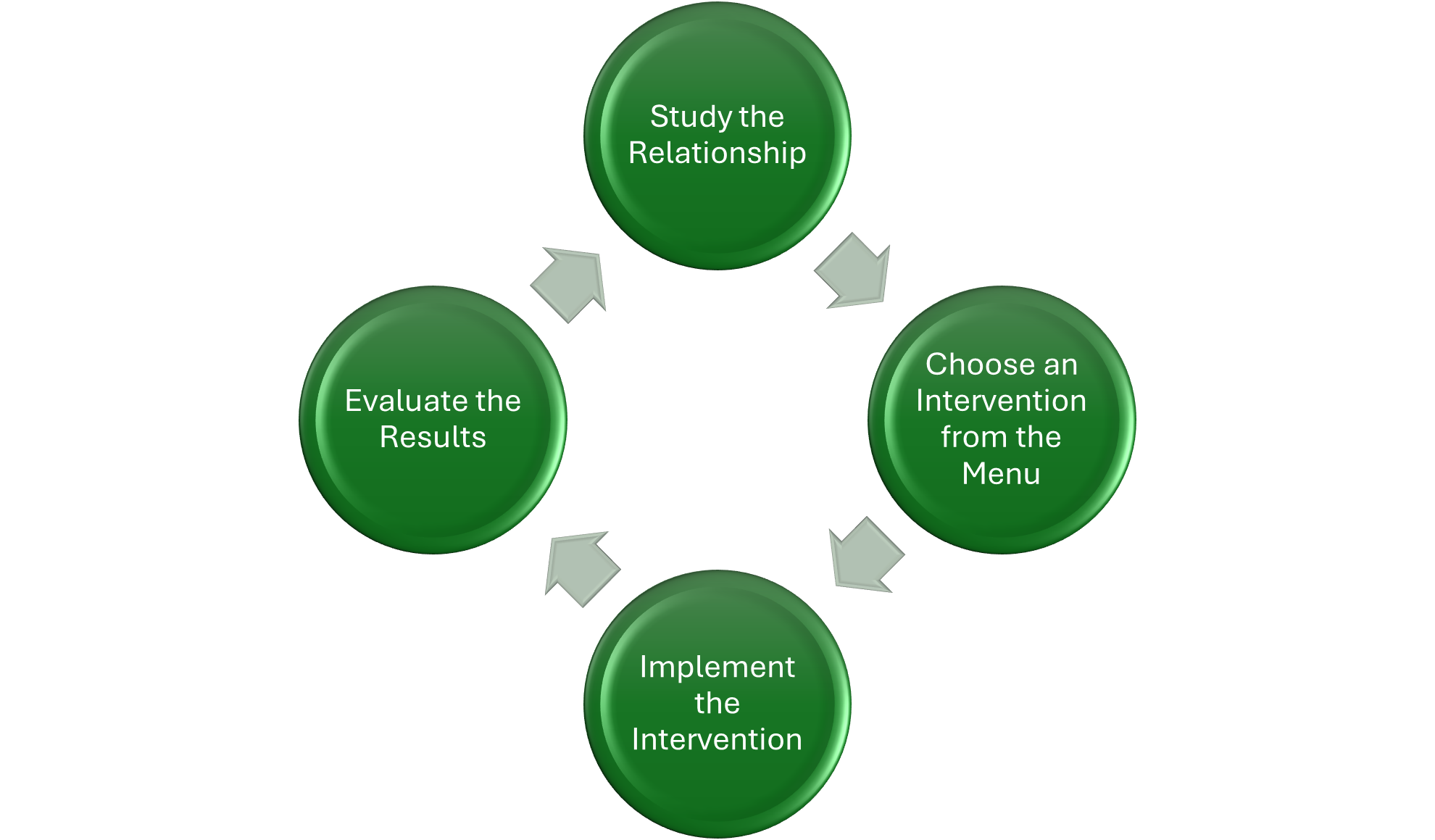
With the Relationship Course Correction Menu, you’ll learn to:
Study the relationship
Choose an intervention from a menu of choices, each with its own clear step by step instructions.
Implement the intervention skillfully.
Study the outcome to see what impact it had, and what work is left to do.
Repeat the process as often as necessary, accumulating many small advantages over a long course of time.
What’s on the Menu?
The Relationship Course Correction Menu includes a range of possible interventions. The earlier options are generally lower-risk and easier to implement. Later options involve higher stakes and depend on the skills developed through earlier steps.

Practice Serenity
Develop practices that help you become more serene in relation to a workplace relationship that has become stressful, upsetting, or preoccupying. The goal is to reduce reactivity so that you can respond more thoughtfully and skillfully.Listen
Create a genuine invitation for the other person to share their perspective. People tend to respond more favorably when they feel heard, and what you learn will help you interact more skillfully.Bond
Strengthen the relationship by connecting outside of immediate work demands — through informal conversation or shared experiences that build goodwill and trust.Give Positive Feedback
Express genuine appreciation when the person does something you would like to see more often. This reinforces constructive behavior and shifts the tone of the relationship.Make a Request
Ask for a specific change using clear, respectful language that increases the likelihood of agreement — while remaining open to the possibility of “no.”Take Responsibility
Acknowledge any ways you may have contributed to the difficulty in the relationship, and make a clear commitment to change your own behavior where appropriate.Ask for Feedback
Invite the other person to share how they experience working with you. Learn to receive feedback skillfully, even when it is difficult or unexpected.Give Constructive Feedback
Address behaviors that are negatively impacting you or the work. Focus on observable actions and their effects, and open a conversation about how things could improve.Describe a Fork in the Road
Clarify the consequences of continuing on the current path and the possibilities available if changes are made. This helps both parties see that the relationship is at a decision point.Escalate through Formal Channels
Recognize when it is appropriate to involve formal organizational structures to address the situation. Used thoughtfully, this can bring clarity, accountability, and support to a relationship that is not improving through informal efforts alone.End the Relationship
Recognize when the relationship is no longer viable and take steps to conclude it professionally, preserving your reputation and future working relationships.
Relationships - A Critical Success Factor in Organizations
“Not finance. Not strategy. Not technology. It is teamwork that remains the ultimate competitive advantage, both because it is so powerful and so rare.” -Patrick Lencioni

You can hire the most talented people, but if they don’t get along, their knowledge, skills, and abilities will not contribute to your organization’s success.
Today’s workplace is diverse, and the problems people are trying to solve together are increasingly complex.
Things are going to get tough. There’s going to be conflict, sometimes intense conflict. Their technical training will not help them.
What happens next will depend on how well they’re prepared.
With the Relationship Course Correction Menu, your people can learn how to build collaborative relationships that become stronger over time. It’s a process grounded in applied psychology, and it takes into account the practical realities of interpersonal dynamics in the workplace. I’ve developed it over many years, and it reflects my 25 years of experience in psychology, human resources, and consulting.
You Don’t Have to Do It Alone

If you’re navigating a difficult workplace relationship — or looking to strengthen your organization’s capacity to handle relationships more effectively —